
I used to read in bed, and I fell asleep on page three of almost every book I started. It took me an embarrassing amount of time to connect the dots: my bed was for sleeping, and my brain knew it. The fix wasn’t a bigger room.
It was a 30-inch-wide corner, one chair, and a lamp, and I finished more books that year than in the three years before it.
That’s what I love about learning how to create a reading nook in a small bedroom: it needs far less space than you’d think, and it changes how the whole room feels.
If your bedroom is small, you’ve probably assumed there’s no spot for a chair, let alone a whole nook. Usually there is. It just hides in corners, window bays, the gap beside a dresser, or the space at the foot of the bed that currently holds a laundry pile.
Because this is a process more than a list of ideas, I’ve laid it out in order: finding the spot, choosing the seat, getting the lighting right, adding storage, and then the details that make it a place you actually want to sit.
After that there’s a comparison of seating options, a budget breakdown, and what I’d do first if I were starting from scratch.
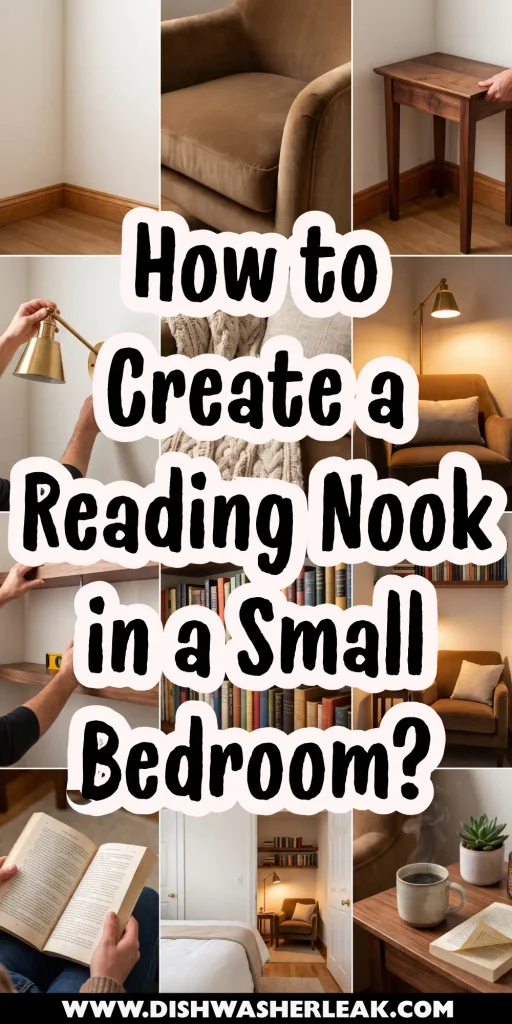
Step 1: Find the Right Spot in Your Small Bedroom
The location matters more than anything you’ll buy. A great chair in the wrong place becomes a clothes rack.
Look at corners first. A corner needs only about 30 by 30 inches for a compact chair and a small side table. Corners also feel naturally sheltered, which is what makes a nook a nook.
Check your windows. Natural light is the best reading light. A chair beside a window, even a small one, gives you daytime reading without a lamp. If you have a deep sill, you may not need a chair at all (see the window seat option below).
Consider the space beside or at the foot of the bed. If your bed is against one wall, the strip along the other side is often wasted. Even 24 inches is enough for a slim accent chair.
Keep your walkway clear. You want roughly 30 inches of clear path to the door and closet. If the nook blocks that, move it or shrink it.
Stay away from the bed’s direct line of sight if you can. This is the part that made the biggest difference for me. When you’re sitting in the nook, you don’t want to be staring at your unmade bed. A slight angle or a small screen changes the feeling completely.
Pro tip: tape the footprint of your chair and side table on the floor with painter’s tape and live with it for a day. If you trip over the tape, you’ll trip over the furniture.
Step 2: Choose Seating That Fits a Small Space
This is where most people overspend or overbuy. Small-space living rewards compact, upright-but-comfortable pieces, and it punishes oversized armchairs.
Compact Accent Chair
The classic choice. Look for a chair around 26 to 30 inches wide with slim arms and legs that lift it off the floor, since visible floor space makes a room feel bigger. A slightly angled back is much more comfortable for reading than a perfectly upright one.
Trade-off: slim chairs are less cushy. If you read for hours, add a lumbar pillow before you add a bigger chair.
Papasan or Round Chair
A round, bowl-shaped chair fits neatly into a corner and feels cozy right away. The downside is that it takes up more floor than it looks, and getting out of one gracefully takes practice.
Floor Cushion or Bean Bag
The most space-efficient option, and easy to tuck away. It works well for people who like to sit cross-legged, but I’d pair it with a wall-mounted backrest or a pillow against the wall, since back support gets old quickly.
Window Seat or Window-Ledge Cushion
If you have a deep sill (at least 12 inches), a custom-cut foam cushion turns it into seating with no floor footprint. For a renter, a cushion and a couple of pillows are completely reversible.
Honest warning: check that the window is safe to sit near and that there’s no radiator or cold draft. A drafty window seat is lovely in June and miserable in January.
Storage Ottoman or Small Bench
If you can’t fit a chair, a storage ottoman against the wall with a pillow behind you doubles as seating and hides blankets or books.
Step 3: Get the Lighting Right (This Is Where Nooks Succeed or Fail)
A cozy chair with bad lighting is just a chair. Reading light needs to be bright enough for your eyes but soft enough to feel like a retreat.
Use a dedicated reading lamp. A floor lamp with an adjustable arm or a slim table lamp works best. Aim the light over your shoulder so it falls on the page without glare.
Choose warm bulbs. Look for 2700K to 3000K. Cooler bulbs feel clinical and make it harder to wind down at night.
Check the brightness. For comfortable reading, you generally want a bulb around 800 lumens or more (roughly equal to an older 60-watt bulb). Dimmer bulbs are fine for ambiance but not for finishing a chapter.
Consider a plug-in wall sconce. If floor space is tight, a wall-mounted sconce with a swing arm frees up the floor entirely. Plug-in versions work for renters, and you can hide the cord with a cord cover.
Add a second, softer light. A small lamp or string of warm lights nearby creates layered lighting, which makes the corner feel more like a destination and less like a spot with a lamp in it.
Pro tip: a lamp with a dimmer or a smart bulb lets you go from bright reading mode to soft evening mode without buying two lights.
Step 4: Add Storage So the Nook Stays Tidy
A reading nook falls apart fast if books, blankets, and mugs have nowhere to go. In a small bedroom, storage has to be vertical or hidden.
Go vertical with shelves. A narrow bookcase or two wall-mounted shelves above the chair keeps your current reads within reach and uses zero floor space. Keep only the books you’re actually reading or love nearby.
Use a small side table with a shelf or drawer. You need somewhere to put a drink, glasses, or a bookmark. A stool, a nesting table, or a slim C-shaped table that slides over the chair arm works well in tight spots.
Keep a basket for blankets. A woven basket beside the chair holds a throw and keeps it from becoming a permanent pile on the chair.
Try a wall-mounted book ledge. Front-facing picture ledges show off covers and look more decorative than a spine-out shelf.
Trade-off: open shelves look great but collect dust and visual clutter. If your bedroom is already busy, a few closed baskets will keep the nook calmer.
Step 5: Make It Feel Like a Retreat (The Finishing Touches)
Once the basics are in, small details are what make you want to sit down.
Add a soft rug. A small rug under the chair defines the nook and warms up hard floors. Make sure the chair legs sit on it, and use a rug pad so nothing shifts.
Layer textures. A knit throw, a linen pillow, and one accent pillow with a different pattern make it feel intentional. Keep the palette tight, so the nook looks like part of the room and not a separate set.
Hang art or a mirror above it. One framed print or a small mirror gives the corner a focal point. Use removable hooks or adhesive strips if your lease bans nails.
Bring in a plant. A small pothos or snake plant on the side table or a wall shelf adds life without taking floor space.
Use a curtain or screen if you want privacy. A lightweight curtain on a tension rod or a folding screen can separate the nook from the rest of the room, which helps if you share the bedroom with a partner.
Pro tip: keep phone chargers out of the nook. If you want to read, the phone should live somewhere else. A charging station on your dresser does more for your reading habit than any chair.
Comparing Seating Options for a Small Bedroom Reading Nook
| Seating type | Typical cost | Floor space needed | Comfort for long reads | Best for |
|---|---|---|---|---|
| Compact accent chair | $150-450 | About 30 x 30 in | Medium to high | Corners, most bedrooms |
| Papasan or round chair | $100-300 | About 36 x 36 in | High | Cozy, casual nooks |
| Floor cushion or bean bag | $40-150 | About 24 x 24 in | Low to medium | Very tight rooms, kids’ rooms |
| Window seat cushion | $50-200 | None | Medium | Bedrooms with deep sills |
| Storage ottoman or bench | $60-200 | About 18 x 30 in | Low to medium | Extra storage plus seating |
If comfort matters most, go with a compact accent chair and a lumbar pillow. If floor space is the bigger problem, the window seat or floor cushion wins.
How Much Does a Small Bedroom Reading Nook Cost?
Here’s a realistic breakdown so you can decide where to spend.
Budget setup (about $75-150): a floor cushion or thrifted chair, a clip-on or thrifted lamp, a basket, and a throw from your existing bedding.
Mid-range setup (about $250-500): a compact accent chair, a floor lamp with an adjustable arm, a small side table, a rug, and a narrow shelf.
Higher-end setup (about $600+): a quality reading chair, a plug-in sconce, custom window seat cushion, and a small bookcase.
If I had to choose where to splurge, I’d put money into the lamp and the chair, since those are the two things you’ll feel every time you sit down. Everything else can be thrifted or DIY.
Common Mistakes to Avoid
Buying a chair that’s too big. Measure the corner first, and remember that a chair with a wide, rolled arm takes more space than the width suggests.
Skipping the lamp. A bright overhead light is not a reading light. You’ll end up back in bed.
Blocking a closet, window, or radiator. Leave at least 30 inches of clearance where you need access.
Making it too perfect to use. If the nook is styled so carefully that you’re afraid to touch it, you won’t sit there. Leave a book out and let the throw look slept-on.
Forgetting the vibe. A nook is a mood. If the corner is next to your treadmill or a pile of laundry, it won’t feel like a retreat.
What I’d Do First If I Were Starting Over
If I were setting up a reading nook in a small bedroom this weekend, I’d start with the lamp and a chair I could sit in for at least twenty minutes in the store.
Then I’d add a small side table and a throw, and hold off on everything else for a couple of weeks. It’s tempting to buy the shelves and plants right away, but you’ll learn a lot about how you actually use the corner in the first few days.
The best way to create a reading nook in a small bedroom is to keep it simple: one comfortable seat, one good light, and one spot to set down your book.
Everything after that is a bonus. Once it exists, you’ll be surprised how often you find yourself curled up there with a book instead of scrolling in bed.


Leave a Reply